How to learn and read tarot: a complete beginner’s guide.
You’ve been drawn to tarot for a reason.
Maybe you’ve shuffled a deck a few times and felt something you couldn't quite name. Maybe you’ve watched someone do a reading and thought: I want to be able to do that. Maybe you’ve owned a deck for years and it'‘ been sitting on your shelf, waiting.
Whatever brought you here, you’re asking the right question: how do you actually learn this?
The honest answer is that tarot is a learnable skill. Not a mystical gift reserved for a specific type of person. Not something you either have or you don’t. A skill, like any other, that develops through study, practice, and a willingness to sit with the cards long enough to understand what they’re saying.
This guide will walk you through everything you need to get started: how the deck is structured, how to approach learning the cards, how to read your first spread, common mistakes to avoid, and what genuine progress looks like. By the end you’ll have a clear path forward, whether you’re picking up a deck for the first time or finally getting serious about a practice you’ve been circling for years.
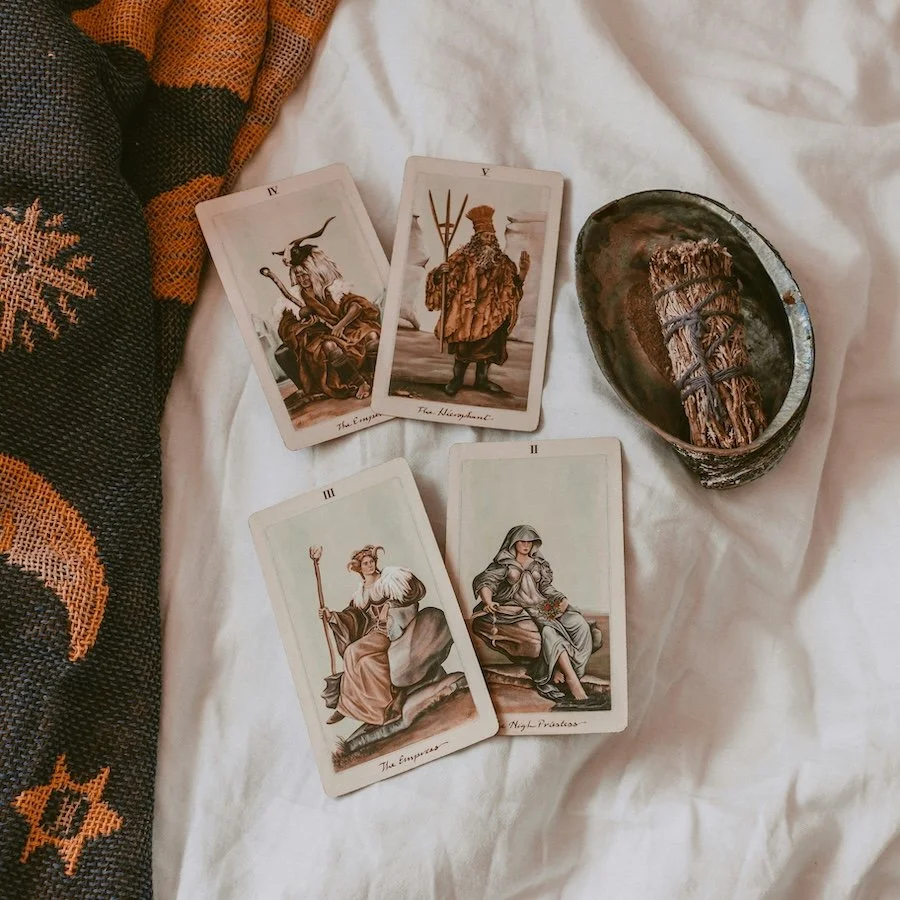
What tarot actually is (and what it isn’t)
Before we talk about how to learn tarot, it’s worth being clear about what tarot is. A lot of misconceptions make the learning process harder than it needs to be.
Tarot is not a fortune-telling tool. The cards do not predict a fixed future. They reflect current energies, patterns, and dynamics, and they invite you to engage with those things consciously rather than react to them unconsciously. Your future is always shaped by your choices. Tarot helps you understand the terrain you're navigating.
Tarot is not about psychic ability. You don’t need to be born with a gift to read tarot. What you need is a genuine understanding of the symbolic language the cards speak, and a willingness to develop that understanding over time.
Tarot is a symbolic language. Each of the 78 cards represents a human experience. Not an abstract concept: a real, lived moment that you have felt, navigated, survived, or are moving through right now. When you understand the cards this way, as reflections of the human journey rather than symbols to memorize, reading tarot stops feeling like a performance and starts feeling like a conversation.
This is the foundation everything else builds on.
Start with the right deck
Before the studying begins, one decision shapes everything that follows: which deck you learn with.
The short answer is the Rider Waite Smith. Every one of its 56 Minor Arcana cards shows a fully illustrated scene rather than an arrangement of symbols, which means the imagery starts teaching you before you’ve read a single definition. And nearly every tarot book, course, and resource of the last hundred years is built around that imagery, so everything you study will speak directly to the cards in your hands.
One note: get the version without keywords printed on the cards. Those annotations feel helpful and become a crutch that prevents you from developing your own relationship with the imagery.
Which beginner deck should I start with?
Understanding the structure of the deck
One of the most important things you can do as a beginner is understand how the tarot deck is organized. The structure is not arbitrary. It’s a map, and knowing how to read the map makes the individual cards dramatically easier to understand.
A standard tarot deck has 78 cards, divided into two sections.
The Major Arcana (22 cards)
The Major Arcana runs from 0 (The Fool) to 21 (The World). These cards represent the major themes, forces, and archetypes of human experience: the big picture energies that shape entire chapters of a life.
The Major Arcana tells a complete story called the Fool's Journey. The Fool begins as pure potential. Open, unformed, ready, and moves through every significant human experience: learning, love, power, loss, spiritual crisis, transformation, and eventual arrival.
By the time you reach The World, the Fool has completed one full cycle and is ready to begin another.
This narrative is not just poetic. It's pedagogical. When you understand where each Major Arcana card sits in the Fool's Journey, you understand what it means before you've memorized a single keyword.
The Minor Arcana (56 cards)
The Minor Arcana covers the day-to-day dimensions of human experience: the practical, emotional, intellectual, and material aspects of living. It's divided into four suits.
Wands deal in fire: passion, creativity, ambition, drive, and the will to become. Wands cards speak to what motivates you, what you're building, and where your energy is directed.
Cups deal in water: emotion, intuition, relationships, and the inner life. Cups cards speak to what you feel, what you love, what you grieve, and what your heart is moving toward.
Swords deal in air: the mind, thought, truth, communication, and the particular pain that clarity sometimes brings. Swords cards speak to how you think, what you know, and what you’re willing to face honestly.
Pentacles deal in earth: the material world, the body, money, work, and the physical reality of a life being built. Pentacles cards speak to what you're creating, what you’re investing in, and what endures.
Each suit runs from Ace (the purest expression of the element) through 10, plus four Court Cards: Page, Knight, Queen, King. These represent different expressions of the suit’s energy as personalities and archetypes.
When you understand the suits and what they govern, you’ve already learned a significant amount about every card in the deck before you've studied a single one individually.
The right way to learn the cards
Here’s the mistake most beginners make: they try to memorize 78 definitions.
They open the guidebook, read “The Tower means sudden change and upheaval,” and try to hold that alongside 77 other definitions. Within a few weeks the definitions blur together, the deck goes back on the shelf, and the person concludes they're just not a tarot person.
This is not a failure of ability. It’s a failure of method.
The right way to learn the cards is through understanding, not memorization.
The Tower doesn'‘ just mean sudden change. It’s every moment your foundation shifted beneath you and you had to decide who you were on the other side. It’s the relationship that ended without warning. The job that disappeared. The belief system that collapsed under the weight of new information. It’s not a warning. It’s a recognition.
When you understand the Tower that way, you never forget it. Because you’ve lived it. The card becomes a mirror for something you already know, not a definition to retrieve.
This is how every card should be learned: by connecting its symbolic content to real human experience, your own experience included.
How to approach each card
When you sit down to study a card, ask these questions.
What does the image show? Look at the card before reading anything about it. What is happening? Who is in the scene? What are they doing? What is the emotional quality of the image?
What elements are present? What suit is it? What number? What do the colors suggest? What symbolic objects appear?
What human experience does this reflect? Not what does this mean, but what is this about as a human experience? What would it feel like to be in this card?
When have I felt this? Connect it to your life. The cards are not abstract. They are reflections of things you have already felt and navigated.
How does it relate to the cards around it in the suit? Each card sits in a sequence. The Five of Cups follows the Four and precedes the Six. Where does this moment fit in the emotional arc of the suit?
This approach takes longer than memorizing keywords. It produces infinitely deeper understanding.
Building a daily practice
The single most important thing you can do to learn tarot is pull at least one card every day.
Not to predict your day. Not to tell your fortune. To practice the skill of interpretation: looking at a card, asking what it's about, and forming your own understanding of what it might be saying.
Here’s a simple daily practice that actually works.
Morning. Pull one card. Look at it. Without consulting a guidebook, ask: what is this card about? What human experience is it reflecting? What might it be saying about today?
Evening. Revisit the card. How did the themes of the card actually show up? Where did you see it reflected? The point is not to find perfect correspondences. It's to develop the habit of noticing.
Journal it. A tarot journal is one of the most valuable tools you can develop. A single sentence per day is enough. Over weeks and months, patterns will emerge, your understanding will deepen, and you'll have a record of your development that is genuinely irreplaceable.
This practice, maintained consistently, will do more for your development as a reader than almost anything else.
How to read tarot cards as a beginner
At some point the studying has to become reading. This is where most beginners stall.
They keep preparing. They read another book, watch another video, and postpone the actual act of sitting down with a deck and doing a reading. But readiness doesn't come from preparation. It comes from doing. The only way to learn to read tarot is to read tarot, imperfectly and uncertainly, starting before you feel qualified.
Here is how to begin.
A spread is a layout of cards where each position has a specific meaning. The position shapes what the card is being asked to address.
The simplest spread is a three-card pull. Three positions, three cards. The meaning of each position is up to you. Common options include:
Past / Present / Future
Situation / Action / Outcome
Mind / Body / Spirit
What to embrace / What to release / What to focus on
To do a three-card reading:
Shuffle your deck while holding a question or intention in mind. It doesn't need to be precise. It can be as simple as: what do I need to understand about my life right now?
Draw three cards and lay them face up, left to right.
Look at each card individually before looking at them as a group. What is this card about? Given the position it's in, what might it be saying?
Then look at the three cards together. What story do they tell? How does the first relate to the second? How does the third resolve or complicate what came before?
The relationship between the cards is often where the most meaningful interpretations live. A card that means one thing in isolation can mean something quite different when it appears alongside specific other cards.
Don’t worry about getting it right. There is no single correct interpretation of any spread. What you’re practicing is the act of interpretation itself: looking at a card, forming a thought about what it's saying, and following that thought where it leads.
Common mistakes to avoid
1. Relying too heavily on the guidebook.
Every tarot deck comes with a guidebook, and guidebooks have their place. But if you consult the book every time you pull a card, you’re learning the author’s interpretation rather than developing your own. Look at the card first. Form your own thoughts. Then, if you want a second perspective, consult a reference and notice where your interpretation overlaps and where it diverges. That comparison is where understanding deepens.
2. Trying to learn all 78 cards at once.
The deck is large. Trying to learn everything at once is the fastest path to overwhelm and abandonment. Start with the Major Arcana. Learn those 22 cards deeply before moving into the suits. Then take each suit one at a time. Depth over breadth, always.
3. Skipping the Court Cards.
The 16 Court Cards are where most beginners get stuck. They’re harder to interpret because they represent personalities and energies rather than events or situations. Don’t skip them. Don’t rush them. Understand each one as an archetype: what kind of person is this, and what energy do they bring?
In a spread, Court Cards can represent actual people in your life. They can represent aspects of yourself. They can represent the energy you’re being asked to embody. Learning to work with these multiple possibilities is one of the markers of a developing reader.
4. Waiting until you know enough to do readings.
You will never feel ready. Do readings before you feel ready. The practice of actually sitting with a spread, forming interpretations, and letting the cards speak is how understanding develops. Reading for yourself when you're uncertain is infinitely more valuable than studying alone until you're certain.
5. Treating reversals as an afterthought.
Reversed cards are a legitimate and nuanced part of tarot reading. Some readers work with them, some don’t. Make a conscious choice about your approach rather than ignoring the question. If you work with reversals, learn what they mean: not always the negative of the upright, but often the shadow expression, the blocked energy, or the internal rather than external dimension of the card.
What does progress actually look like?
Learning tarot is not linear. There are weeks where everything clicks and weeks where nothing makes sense. That is normal and expected.
Genuine progress looks like this.
You pull a card you haven’t studied recently and you have a felt sense of what it’s about before you consult any reference. That felt sense is not random. It’s understanding that has been internalized through repeated engagement.
You look at a spread and the narrative emerges naturally, rather than having to force connections between individual card meanings.
You sit with a difficult card, one you don’t know or one whose message feels uncomfortable, and instead of reaching for the guidebook you sit with the image and let it speak.
You begin to notice the cards in your daily life: the Tower moment in a news story, the Six of Cups quality in a conversation with an old friend, the High Priestess feeling when something is known but not yet sayable.
This is what it means to have genuinely learned tarot. Not the ability to recite 78 definitions, but the development of a symbolic literacy that you carry with you everywhere.
How long does it take?
Most dedicated students learn the cards in three to six months, and genuine confidence arrives somewhere between six months and two years of consistent practice.
An honest, step-by-step timeline.
The next step
If you’re ready to learn tarot with confidence, Tarot Academy was built for you.
It's a complete online course covering all 78 cards across 20 chapters: from the history of tarot and the structure of the deck all the way through reading for others, developing your personal style, and opening a professional practice for those who want it.
142+ video lessons. 37+ hours of instruction. Lifetime access.
Tarot Academy
The Only Tarot Course You’ll Ever Need
Most tarot courses end at the cards: Tarot Academy takes you all the way. From learning all 78 cards in full depth, to developing your intuition, to launching a professional tarot practice.